Threading the Light: The Projectionists Who Refuse to Let 35mm Cinema Die
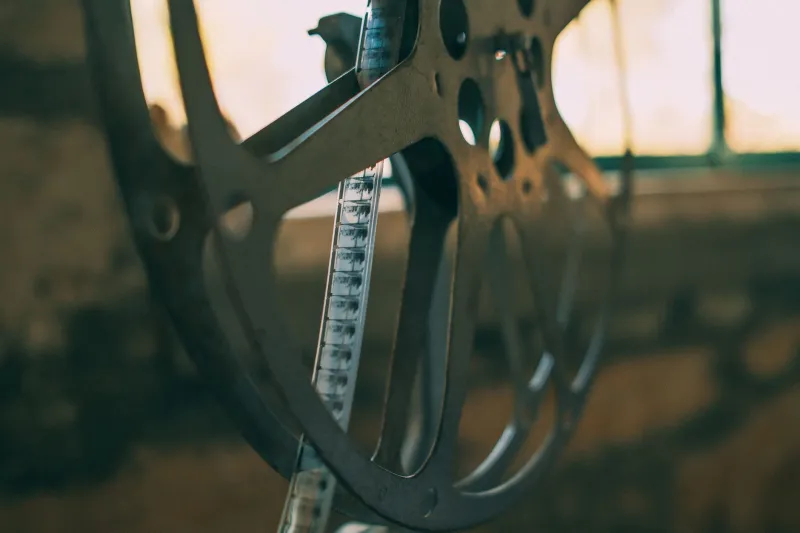
The projection booth at the Majestic Theater in Carthage, Missouri, smells of machine oil, warm metal, and something harder to name—perhaps time itself. The room is narrow enough that two people standing side by side would brush shoulders, and nearly every inch of wall space is occupied by spare reels, coiled leaders, and hand-labeled canisters stacked with the quiet orderliness of a private archive. At the center of it all stands a Simplex E-7 projector, a machine manufactured in the 1950s and still threading film with a mechanical precision that its current operator, sixty-three-year-old Dennis Hargrove, describes without irony as "better than anything they make today."
Hargrove has run the Majestic's projection booth for thirty-one years. He learned the trade from the man who held the job before him, a retired railroad worker named Earl who communicated mostly in grunts and demonstrated rather than explained. "Earl never told you how to do something twice," Hargrove recalls. "You watched, you remembered, and you didn't ask him to repeat himself." That apprenticeship model—informal, embodied, passed hand to hand like a family recipe—is how the craft of film projection has survived into the twenty-first century. It is also, many in the field now acknowledge, exactly why it is so precarious.
A Craft the Industry Left Behind
The American cinema industry's transition to digital projection, which accelerated sharply between 2010 and 2013, was not merely a technological upgrade. It was, for projectionists, something closer to an erasure. Digital systems require far less specialized labor: a server loads the content, automated software triggers the show, and the human role is reduced largely to troubleshooting. The International Alliance of Theatrical Stage Employees, the union that once represented projectionists in major markets, saw its projection locals hollowed out over the course of a single decade. Many experienced operators took early retirement packages. Others were absorbed into broader theater technician roles. The craft, as a distinct professional identity, largely ceased to exist in the multiplex world.
But it did not disappear entirely. Scattered across the country—in county seats, college towns, and historic districts that resisted the multiplex model—a cohort of independent single-screen theaters chose not to convert. Some lacked the capital. Others made a deliberate philosophical choice. A few simply had operators like Hargrove who refused to regard their equipment as obsolete.
The nonprofit Cinema Preservation Alliance estimates that fewer than four hundred venues in the United States still operate 35mm projection equipment on a regular basis. Of those, perhaps half do so exclusively, without a digital backup. The projectionists who maintain them represent one of the most concentrated repositories of mechanical film knowledge remaining in the country—and their average age is well past fifty.
The Parts Problem
Maintaining a 35mm projector in working condition in 2024 is an exercise in creative resourcefulness. Manufacturers stopped producing most replacement components decades ago. Lubricants formulated specifically for vintage projection equipment have become specialty items, sourced from small-batch suppliers or improvised from industrial equivalents. Lenses, lamp housings, and shutter mechanisms must be hunted through a loose national network of retired projectionists, theater liquidators, and salvage dealers who strip decommissioned equipment before it reaches the scrapyard.
Rachel Okonkwo, who operates the single-screen Starlight Cinema in Oberlin, Ohio, maintains a spreadsheet she calls her "parts ledger"—a running inventory of components she has acquired speculatively, before she needs them, because she has learned that waiting until a part fails means waiting indefinitely. "There's a guy in Cincinnati who pulls parts from old drive-ins before they demolish them," she explains. "There's another one in Oregon who does the same thing out West. You build relationships. You trade. You hoard, honestly, in the best possible sense."
Okonkwo, thirty-eight, is among the youngest full-time projectionists still working in analog exclusively. She came to the trade sideways, through a film studies program at Oberlin College, where a faculty mentor introduced her to the Starlight's aging operator during her junior year. She spent two years learning before he retired. "He told me I was the only person who had ever asked," she says. "Not the only young person. The only person, period, in years."
Teaching What Cannot Be Googled
The transmission of projection knowledge presents a challenge that distinguishes it from most other endangered crafts: it is almost entirely tactile and situational. A projectionist learns to read a machine through vibration, sound, and the specific quality of light on a screen. They learn to feel when a feed mechanism is running too tight, to hear the difference between a shutter that is performing correctly and one that is beginning to fail. No manual fully captures this. No online tutorial replicates the experience of standing beside someone who has run ten thousand shows.
Some in the community have begun organizing informal apprenticeship programs, pairing experienced operators with younger enthusiasts through regional cinema preservation networks. The Rochester, New York–based Visual Studies Workshop has hosted projection workshops drawing participants from as far as Texas and the Pacific Northwest. The Alamo Drafthouse's repertory programming arm has quietly invested in keeping analog projection staff trained at select locations. These efforts are meaningful, but they remain fragmented—coordinated by passion rather than by institutional infrastructure.
What is largely absent is sustained funding. Unlike film archives or library preservation programs, working projectionists receive almost no public support. Grants available through the National Endowment for the Arts or state humanities councils are typically directed toward preservation of film content rather than preservation of the human knowledge required to exhibit it. The distinction may seem technical, but its consequences are significant: a 35mm print of a film held in a climate-controlled vault is only as useful as the number of people who know how to show it.
What the Screen Knows
Ask any experienced projectionist why 35mm still matters, and they will eventually arrive at something beyond the technical. They will describe the way grain structures give celluloid an organic depth that digital projection, however crisp, does not replicate. They will talk about the specific quality of projected light passing through a physical medium—a warmth, a slight imperfection, a sense of presence that audiences register even when they cannot name it.
Dennis Hargrove puts it plainly. "Digital is accurate," he says, adjusting the framing on a reel of a 1973 Western he is preparing for a Saturday matinee. "Film is alive. There's a difference." He is not making a nostalgic argument, or at least not only that. He is making a perceptual one—and a cultural one. The experience of watching film projected on celluloid, he believes, connects an audience to something about the history of cinema that a digital file, however faithfully restored, cannot fully convey.
Whether that argument will be sufficient to sustain the craft beyond the current generation of practitioners is an open question. The Majestic seats two hundred and twenty people. On a good Friday night, Hargrove fills perhaps a hundred and forty of them. He has one person he is training, a twenty-six-year-old named Marcus who works at the hardware store during the week and comes in on weekends to learn the machines. Marcus is careful and attentive. Hargrove is cautiously hopeful.
"I'm not trying to save the movies," Hargrove says, closing the gate on the Simplex and stepping back to check the alignment. "The movies are fine. I'm just trying to make sure somebody still knows how to show them right."