Refusing the Cloud: Why Some of America's Smallest Museums Are Betting the Past on Paper
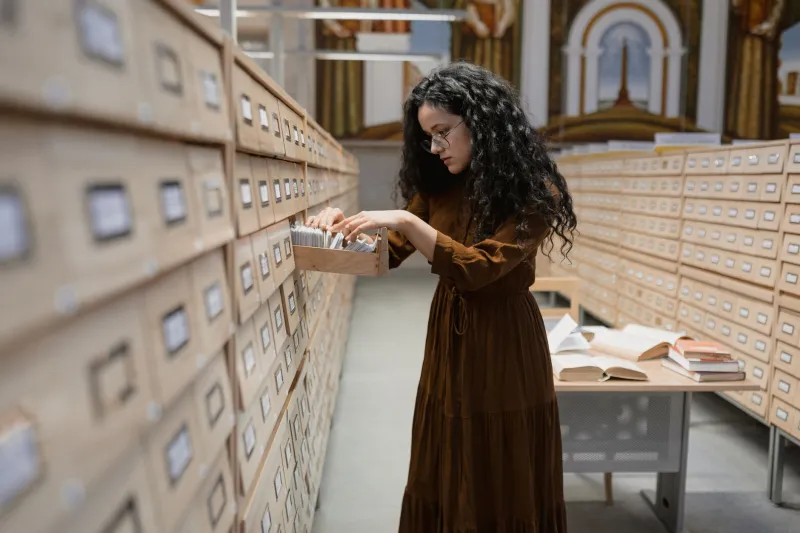
In a converted grain warehouse on the outskirts of Gallup, New Mexico, a retired schoolteacher named Dolores Runningwater spends her Tuesday mornings updating a card catalog. The cards are handwritten in her careful, deliberate cursive. Each one documents a textile, a photograph, a piece of pottery, or a personal letter donated by families from the surrounding Navajo Nation communities. The catalog has no digital counterpart. There is no backup server. There is no URL.
This is not an oversight. It is a philosophy.
"When you put something online, you lose control of it," Runningwater says, smoothing a fresh index card against the wooden drawer. "You lose who sees it, who takes it, who decides what it means. These things belong to the people who gave them to us. We owe them more than a database."
Runningwater's small institution, the High Desert Heritage Room, is one of dozens of independent museums across the United States that have quietly, and in some cases vocally, chosen analog preservation over digital migration. Their reasons are varied, their resources are scarce, and their decisions carry consequences that will echo long after the people making them are gone.
A Quiet Rebellion Against the Digital Default
For the better part of two decades, the cultural preservation establishment has operated under a near-universal assumption: digitization is salvation. Institutions from the Smithsonian to the smallest county historical society have been urged, funded, and in some cases pressured to move their holdings online. The arguments are compelling. Digital archives are searchable, shareable, and theoretically immune to the physical decay that threatens paper, fabric, and film.
But a growing number of small museums are pushing back, and their resistance is rooted in something more substantive than technophobia or budget constraints. For many of these institutions — particularly those stewarding the cultural heritage of Indigenous, immigrant, and working-class communities — the digital infrastructure that promises preservation also carries risks that mainstream archival discourse has been slow to reckon with.
Cybersecurity vulnerabilities have shuttered digital archives without warning. Proprietary software formats have rendered collections unreadable within a single decade. Cloud storage agreements have buried ownership rights in terms-of-service language that few curators have the legal resources to fully parse. And for communities whose histories have already been extracted, misrepresented, or commercialized by outside institutions, surrendering materials to platforms governed by corporate interests represents not progress, but a familiar pattern of dispossession.
"We've seen what happens when someone else gets to tell our story," says Marcus Delgado, director of the Miner's Memory Project in Centralia, Pennsylvania, a small archive documenting the labor history of the region's anthracite coal communities. "We digitized part of our collection in 2014 through a partnership with a university. Two years later, the university restructured its digital humanities program. Those files are sitting on a server somewhere that nobody at that institution has a budget to maintain. Our paper records are still here, still readable."
The Paradox of Protection Through Obscurity
The irony at the heart of analog resistance is difficult to ignore. The same opacity that protects a collection from data breaches, corporate appropriation, and algorithmic distortion also makes it functionally invisible to the public it is meant to serve. A hand-cataloged archive in Gallup, New Mexico cannot be discovered by a researcher in Portland, Oregon. A physical photograph stored in acid-free sleeves in Centralia cannot be viewed by a descendant living in Pittsburgh who doesn't know the archive exists.
This tension — between protection and access — is one that analog-committed institutions navigate with varying degrees of comfort and clarity. Some frame limited access as an intentional feature, particularly when collections contain sensitive ceremonial materials or personal records that community members have explicitly asked not to be made widely available. Others acknowledge the trade-off with visible unease, aware that what cannot be found may, for all practical purposes, cease to exist in the broader cultural conversation.
"There's a version of preservation that's really just hoarding," admits Carla Osei, a collections manager at a small African American history museum in Birmingham, Alabama. "If the people whose history this is can't get to it, then who are we preserving it for?" Her institution maintains physical records but has begun experimenting with a limited, community-controlled digital index — not an online archive, but a searchable list of what exists and how to request access. It is a compromise that satisfies no ideological camp entirely, which may be precisely why it works.
Who Decides What Gets Remembered?
Beneath the practical debates about file formats and server costs lies a more fundamental question, one that small analog-committed museums are forcing into the open with uncomfortable clarity: Who holds the authority to determine how a community's history is stored, accessed, and interpreted?
Large institutions — national museums, universities, well-funded historical societies — have long exercised that authority by default, their digitization projects shaping what becomes searchable and therefore, in the modern information economy, what becomes real. The communities whose materials fill those databases are rarely the ones writing the metadata, selecting the search terms, or deciding which items receive conservation priority.
Analog resistance, at its most coherent, is a refusal of that arrangement. It is an assertion that the communities most affected by historical erasure should retain direct, physical, unmediated control over their own records — even if that control comes at the cost of broader visibility.
"The internet doesn't preserve things," says Runningwater, closing the catalog drawer with a soft click. "It circulates them. That's not the same thing. Circulation means someone else always has their hands on it."
The Reckoning That's Coming
No one working in analog preservation is naive about mortality — their own or their institutions'. Card catalogs require human beings who know how to read and maintain them. Physical collections require climate control, pest management, and continuous funding that most of these organizations cannot reliably secure. The volunteers who carry institutional knowledge in their heads will retire, relocate, or die. The buildings that house these collections are vulnerable to fire, flood, and the slow attrition of deferred maintenance.
In that sense, analog resistance is not a permanent solution. It is, at best, a principled delay — a choice to hold ground while the cultural preservation field catches up to the legitimate concerns these small institutions have been raising for years. Concerns about data sovereignty, community consent, corporate intermediaries, and the difference between making something accessible and making something safe.
The question that lingers over every hand-labeled folder and every carefully maintained card catalog is not whether these collections will eventually need to find a more sustainable path. They will. The question is whether the institutions and funders with the resources to help them will finally begin listening to what these small, underfunded, analog-committed museums have been trying to say — that preservation is not a technical problem. It is a political one.
Dolores Runningwater slides another card into the drawer and reaches for her pen. Outside the warehouse windows, the high desert light is flat and white and indifferent. The catalog grows by one.