Silver and Shadow: The Quiet Insurgency Keeping Film Photography Alive in a World of Infinite Pixels
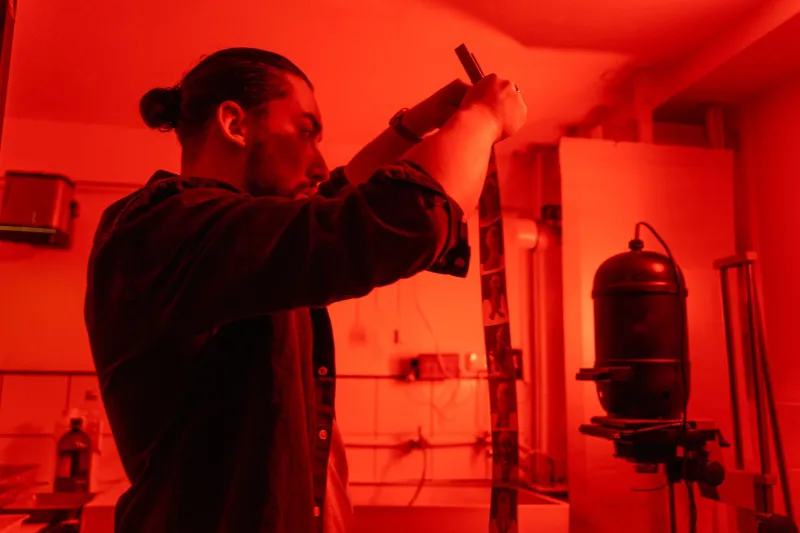
In a converted garage in East Nashville, the air carries the unmistakable scent of fixer solution — that sharp, mineral tang that older photographers recognize the way others recognize the smell of rain on hot asphalt. Shelves hold amber bottles of developer, stop bath, and hypo in careful rows. A red safelight casts the room in the particular warmth of a medium that, by every commercial measure, should no longer exist. And yet here, as in dozens of similar spaces from Portland to Pittsburgh, someone is loading a roll of 35mm film into a developing tank and choosing, deliberately, to slow down.
The resurgence of analog photography in the United States is not a nostalgic quirk confined to vintage markets and college art departments. It is, for a growing number of practitioners, a considered philosophical and political stance — one that carries implications extending well beyond aesthetics.
The Economy of Scarcity
The infrastructure that sustains film photography in 2024 is fragile in ways that most casual observers do not appreciate. The United States once supported hundreds of commercial film processing labs; today, that number has contracted to a handful of regional operations and a small network of dedicated independent processors. Kodak, which filed for bankruptcy in 2012 before restructuring, has resumed film production, and Ilford — a British manufacturer with deep American distribution — continues to supply black-and-white stock. But the chemical supply chain remains precarious. Several key photographic chemistry compounds are now sourced from suppliers who serve industrial rather than photographic markets, leaving film labs vulnerable to shortages that have no obvious domestic remedy.
Film costs have risen sharply. A roll of color negative film that retailed for around four dollars a decade ago now frequently sells for twelve to sixteen dollars, before processing fees. For documentary photographers working on limited budgets, this scarcity is not merely inconvenient — it is structurally exclusionary. Community darkroom cooperatives in cities including Chicago, Philadelphia, and Los Angeles have responded by subsidizing memberships for low-income artists, bulk-purchasing chemistry to reduce per-print costs, and offering sliding-scale access to enlargers and darkroom time. These cooperatives function, in many respects, as mutual aid organizations built around a medium.
Resistance as Methodology
The political dimensions of the analog revival are difficult to separate from its aesthetic ones. A recurring argument among practitioners is that film photography, by its very nature, resists the logic of algorithmic mediation. A digital image, the moment it is captured, enters a processing pipeline: sharpening algorithms, exposure normalization, facial recognition tagging, platform compression. The photographer's intention is filtered through layers of automated interpretation before it reaches any viewer. Film, by contrast, produces a physical object — a negative — that exists independently of any platform, any server, any terms-of-service agreement.
For documentary photographers working in communities that have historically been misrepresented or surveilled by photographic technology, this distinction carries genuine weight. Several photographers working to document Indigenous communities in the American Southwest have explicitly chosen film as a means of retaining physical control over their images — prints and negatives that can be held, stored locally, and distributed on the community's own terms rather than through platforms whose data practices remain opaque.
Activist photographers covering protest movements have similarly noted practical advantages: film cameras contain no GPS metadata, no wireless connectivity, and no cloud backup. An image exists where it is made, and nowhere else, until the photographer chooses otherwise.
The Technicians Holding the Medium Together
Behind every functioning darkroom is a supply chain that depends on a small number of highly specialized technicians and suppliers whose work is almost entirely invisible to the broader culture. Photographic chemistry requires careful formulation; improperly mixed developer can destroy an irreplaceable negative. Enlarger lenses, many of which were manufactured decades ago by companies that no longer exist, must be sourced through secondary markets and maintained by technicians who learned their craft in eras when such knowledge was commonplace.
The knowledge itself is at risk of disappearing. Organizations including the George Eastman Museum in Rochester, New York — the former home of Kodak's founder and now one of the world's foremost repositories of photographic history — have invested in educational programming designed to transfer technical expertise to younger practitioners. Community colleges in several states have quietly maintained darkroom facilities that serve both degree-seeking students and community members, functioning as informal preservation sites for a practical knowledge base that has no digital equivalent.
In Brooklyn, a small cooperative laboratory has begun offering apprenticeship programs specifically targeting photographers from working-class backgrounds, pairing technical training with access to equipment that would otherwise be financially inaccessible. The program's founders describe it in terms that would be familiar to labor historians: skill transfer, material access, and the deliberate democratization of a craft.
What the Grain Carries
There is a phenomenological argument for film that its advocates make with increasing sophistication. The grain structure of a film image — those silver halide crystals that give analog photographs their characteristic texture — is not a flaw to be engineered away but a record of light's physical interaction with a material surface. Every frame of film is, in a literal chemical sense, touched by the world it depicts. No algorithm produced it. No server processed it. The image and the moment it records share a physical continuity that digital capture, for all its technical superiority, cannot replicate.
This is not mere sentimentality. For archivists and historians, the permanence of properly processed and stored film negatives represents a genuine preservation advantage. Black-and-white silver gelatin prints, stored under appropriate conditions, can remain legible for centuries. Digital files, by contrast, are only as durable as the formats and hardware capable of reading them — a consideration that archivists at institutions across the country are grappling with urgently as file formats become obsolete and storage media degrade.
The Blink of a Shutter
What is perhaps most striking about the analog revival is its self-awareness. The photographers, technicians, and cooperative organizers sustaining this medium are not under the illusion that film will reclaim its commercial dominance. They are not nostalgists longing for a pre-digital past. They are, rather, people who have examined what the digital transition has cost — in terms of deliberateness, materiality, privacy, and community — and decided that some of those costs are worth refusing.
In that refusal, there is something that feels consonant with a broader cultural moment in which the promises of frictionless technology are being scrutinized with growing skepticism. The darkroom, with its enforced patience and its irreversible chemistry, offers a different kind of discipline: the discipline of commitment, of consequence, of images that cannot be deleted with a swipe.
The medium is fragile. The infrastructure sustaining it is thin. But the people keeping it alive are, in their own quiet way, insisting that some things are worth the difficulty of preserving — and that the act of preservation is itself a form of meaning-making that no algorithm has yet learned to perform.