The Human at the Other End of the Line: America's Last Switchboard Operators and the Infrastructure They Carry in Their Heads
There is a particular kind of knowledge that cannot be downloaded, indexed, or replicated by a routing algorithm. It lives in the hands of a woman in a small Missouri county seat who has spent thirty-one years plugging calls through a manual board, and who knows without being told that when Earl Hutchins calls the courthouse at 8:47 on a Tuesday morning, he needs to be transferred to the tax assessor's office — not the clerk's window, not the recorder's desk, but specifically to Linda, who has handled Earl's family's property questions for a decade. No automated directory tree arrives at that conclusion. No voice-recognition prompt anticipates it. Only a person does.
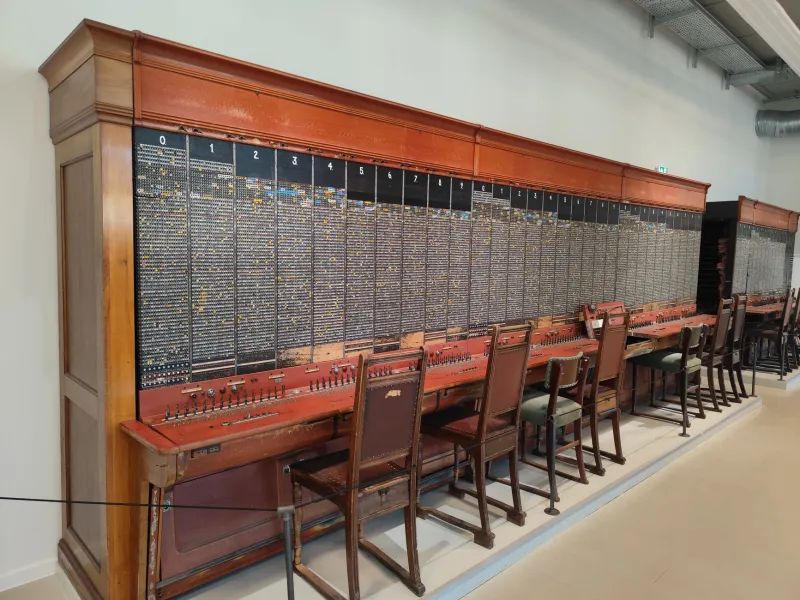
Across the United States, the human telephone switchboard operator has become something approaching a living artifact — a practitioner of a craft that the broader culture declared obsolete before most working Americans were born. Yet they persist. In rural hospitals. In federal correctional facilities. In tribal government offices. In a handful of legacy corporate campuses that never fully modernized their internal communications infrastructure. They persist not as curiosities, but as functional nodes in systems that, for various reasons — financial, regulatory, geographic, or simply human — have not made the leap to full automation.
What their continued existence reveals about the nature of infrastructure, community, and the cost of frictionless efficiency is worth examining carefully.
The Craft That Automation Declared Dead Too Early
The popular imagination tends to fix the switchboard operator in amber somewhere around 1965 — a figure of mid-century Americana, immortalized in black-and-white photographs, rendered nostalgic by the rotary dial's own obsolescence. The reality is considerably more complicated. Manual switchboard systems remained standard in many rural telephone cooperatives well into the 1980s, and vestiges of human-mediated connection survived in specialized institutional settings long after that.
The operators who remain active today are not hobbyists or historical reenactors. They are professionals managing live communications infrastructure in environments where human judgment, local knowledge, and real-time discretion still outperform automated alternatives. In a rural critical-access hospital in eastern Kentucky, for instance, a single operator managing the facility's internal and external call routing must distinguish between a routine appointment inquiry and a physician calling in from a vehicle accident on a mountain road — and must make that determination in seconds, without the benefit of metadata tags or algorithmic priority scoring.
"The machine doesn't know context," says one operator who has worked at a small county hospital for nearly two decades. "I know the voices. I know when something is wrong before the person on the line has finished their first sentence."
That capacity — what might be called contextual listening — is not a soft skill. It is a precision instrument, developed over years of practice, and it is vanishing.
What the Algorithm Cannot Hear
The case for automated call routing is not difficult to make on purely economic grounds. Modern private branch exchange systems and voice-over-IP platforms can handle thousands of simultaneous calls, route by keyword recognition, and generate detailed usage analytics at a fraction of the cost of a human operator's salary and benefits. For large institutions processing high call volumes with relatively standardized inquiries, the efficiency argument is essentially unassailable.
But efficiency has a shadow side, and that shadow falls most heavily on the communities and individuals for whom standardization is itself a form of exclusion. Elderly callers who struggle to navigate multi-tier phone menus. Non-English speakers attempting to reach government services. Individuals in mental health crises who need a human voice before they can articulate what kind of help they require. In each of these cases, the removal of a human intermediary does not simply streamline a process — it erects a barrier where a door once stood open.
Researchers studying rural healthcare access have documented measurable differences in patient outcomes at facilities that maintained human operator staffing compared to those that transitioned fully to automated systems. The differences are most pronounced among elderly patients and those with cognitive impairments, for whom a familiar voice and patient redirection can mean the difference between successfully accessing care and abandoning the attempt entirely.
This is not sentiment. It is infrastructure failure with human consequences.
The Institutional Memory Problem
Beyond the immediate functional value of human operators lies a subtler and more troubling issue: the loss of institutional memory that their retirement or displacement produces. An experienced switchboard operator in a government facility or long-standing private institution carries in her head a map of that organization's actual communication patterns — not the official org chart, but the real network of who calls whom, which lines are perpetually congested, which extensions have been informally reassigned, and which callers require special handling.
This knowledge is almost never formally documented. It exists as a form of tacit expertise, transmitted through apprenticeship when conditions allow and simply lost when they do not. When a facility transitions to an automated system without adequately capturing and encoding this institutional knowledge, it does not merely swap one technology for another. It discards a living archive.
"When I retire, a lot of what I know about how this place actually works goes with me," one federal facility operator observed during a conversation about her pending departure. "They'll have the directory. They won't have the map."
Preservation as a Policy Question
The preservation of human switchboard operation is not, at its core, a question of nostalgia. It is a question of what values a society encodes into its critical infrastructure. The decision to automate a communications system is rarely presented as a values choice — it is presented as a financial and operational one, with efficiency as the governing metric. But every infrastructure decision carries embedded assumptions about who the system is designed to serve and what kinds of human needs it is willing to accommodate.
Some tribal nations and rural cooperatives have arrived at a deliberate conclusion that human operators represent not a cost to be eliminated but a service worth sustaining. They have done so not out of technological conservatism but out of a clear-eyed assessment of their communities' actual needs. In these contexts, the switchboard operator functions less as a communications technician and more as a community liaison — a trusted intermediary who knows the territory in ways that no server farm ever will.
There is a policy argument to be made here, one that progressive infrastructure advocates have been slow to articulate: that the presence of human intermediaries in critical communications systems is a form of accessibility infrastructure, and that its erosion disproportionately harms the communities — rural, elderly, linguistically isolated — that are already most vulnerable to systemic neglect.
The Blink of a Connection
There is something worth sitting with in the image of a woman at a manual board, a cord in her hand, making a connection that a machine could make faster and cheaper. The speed and the cost are real. So is what the machine cannot do: recognize the tremor in a familiar voice, hold the line an extra moment for someone who needs to gather themselves, know without asking that this call is different from the last ten thousand calls that sounded just like it.
The last switchboard operators are not standing in the way of progress. They are holding open a door that progress, in its haste, keeps trying to let swing shut. What we choose to do with the time they are buying us — whether we document their knowledge, encode their judgment into better systems, or simply wait for them to retire and call the problem solved — will say something lasting about the kind of infrastructure, and the kind of society, we are actually building.