Chemical Memory: The Film Lab Technicians Carrying an Endangered Craft Into an Uncertain Future
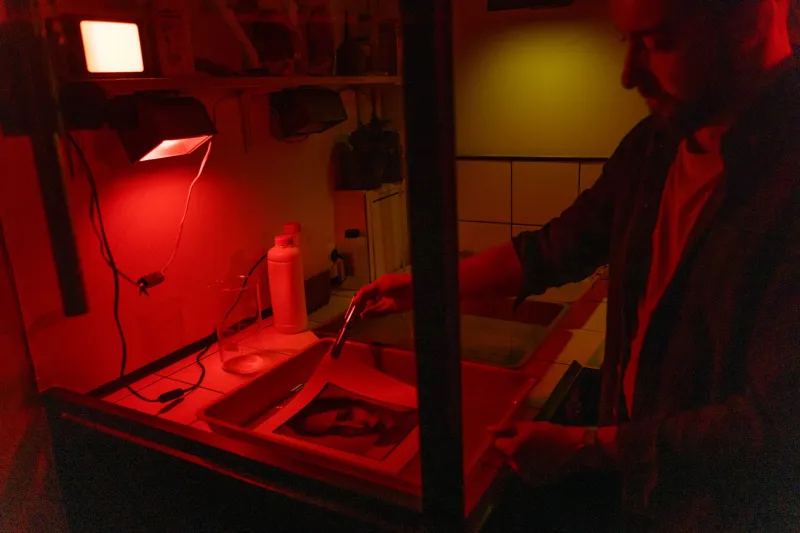
In a narrow building in a mid-sized American city, behind a door marked with faded safety warnings, a technician named Carol Reyes moves through a room that smells of vinegar and something older — something almost geological. She adjusts the temperature of a chemical bath by fractions of a degree, consults a logbook filled with handwritten notations accumulated over three decades, and listens to the sound of film traveling through a machine that has not been manufactured since the 1990s. She knows this machine the way a physician knows a patient's history: intimately, intuitively, and with an awareness of everything that can go wrong.
Reyes is one of a diminishing cohort of color film lab technicians still operating in the United States. She processes both photographic film and motion picture stock — C-41 for consumer color negatives, E-6 for slide film, ECN-2 for cinema. These are not simply chemical formulas that can be looked up and replicated. They are living processes, sensitive to ambient temperature, water mineral content, equipment age, and the accumulated institutional knowledge of the people who run them. And that knowledge, as Reyes will tell you without hesitation, is disappearing.
A Collapse Hidden in Plain Sight
The decline of analog film processing in America has unfolded gradually enough that most people failed to notice it as a crisis. The consumer market for film photography shrank dramatically in the early 2000s as digital cameras became affordable and ubiquitous. Major retail chains shuttered their in-store labs. Kodak filed for bankruptcy in 2012. Professional labs consolidated, then closed. The infrastructure that once supported a nationwide culture of analog image-making contracted to a fraction of its former scale.
What remained was a patchwork of independent labs, university darkrooms, and a handful of specialty facilities serving professional photographers, independent filmmakers, and a younger generation of enthusiasts who had rediscovered film as an artistic medium. This revival generated genuine optimism within the analog community. Film sales have, in fact, increased over the past several years. But production and processing are not the same challenge. You can manufacture more film. You cannot simply manufacture more technicians who know how to process it correctly.
"People celebrate that film is coming back," says Marcus Thorn, who operates a small lab in the Pacific Northwest and has been processing film for twenty-six years. "What they don't always understand is that the processing side didn't come back with it. The knowledge base is older than it looks. A lot of the people who really know this work are in their fifties and sixties, and they're not being replaced at anywhere near the rate they're retiring."
What Is Being Lost
The technical dimensions of analog film processing are not easily summarized, and that is precisely the problem. Color negative processing involves precise chemical replenishment cycles, temperature controls measured in tenths of a degree, and equipment calibration that varies by machine, by chemistry batch, and by the specific film stock being processed. Errors are irreversible. Unlike a corrupted digital file, a ruined roll of film cannot be restored. The images are gone.
Beyond the chemistry, the machines themselves present a preservation crisis. The processors used in professional labs — Jobo units, Colenta processors, Kodak Versamat models — are no longer produced. Parts are scarce. Repairs require either salvaged components or fabricated replacements. Several technicians interviewed for this article described maintaining machines the way a small-town mechanic might maintain a vintage truck: through improvisation, community knowledge-sharing, and an almost archaeological relationship with available parts.
"I have a processor that I've been keeping alive for fifteen years," says Diana Osei, who runs a lab in the Southeast and specializes in motion picture film processing. "I know where every part came from. I know which components are original and which ones I had machined because I couldn't find them anywhere. If I retire and no one learns what I know about that machine, it's not just a machine that stops working. It's a capability that disappears."
The Documentation Effort
In response to this slow-motion crisis, a loose network of technicians, archivists, and film advocates has begun an urgent project of documentation. Some are producing detailed written guides to chemical processes and machine maintenance. Others are recording video walkthroughs of their lab procedures — not polished instructional content, but working footage meant to capture the tacit knowledge that resists formal description. A few have partnered with film schools and university programs to formalize apprenticeships.
The effort is fragmented and underfunded, relying largely on the voluntary labor of the very people whose time is most constrained. Thorn has spent evenings over the past two years recording himself at work, narrating decisions he would otherwise make silently and automatically. "You don't realize how much you know until you try to explain it," he says. "The things that seem obvious to me after twenty-six years — those are exactly the things that never get written down."
Some institutions have taken notice. A small number of film preservation organizations and arts nonprofits have begun directing resources toward lab documentation and technician training. The Academy of Motion Picture Arts and Sciences has maintained long-standing programs in film preservation, and several independent archives have expanded their scope to include processing knowledge alongside the films themselves. But the scale of institutional support remains far below what advocates consider adequate.
The Next Generation, and the Gap It Must Cross
There is, notably, a new generation of people interested in learning analog film processing. Younger photographers and filmmakers drawn to the medium are increasingly curious about the full chain of production, from exposure through development. Several labs report growing interest in hands-on training. The demand exists. What is less certain is whether the supply of experienced teachers will persist long enough to meet it.
"I want to teach," Reyes says. "I've had people come through here to learn, and some of them are genuinely talented. But I can't teach someone in a weekend what took me thirty years to understand. And I don't have the infrastructure to run a formal program on my own. I'm keeping the lab running. I'm barely keeping the lab running."
This tension — between the desire to transmit knowledge and the practical limits of small, financially precarious operations — defines the situation facing analog film processing in America. The labs that remain are not large institutions with training departments and succession plans. They are, in most cases, small businesses sustained by the dedication of a single practitioner or a tiny team, operating on margins that leave little room for anything beyond survival.
A Larger Question About Cultural Infrastructure
The story of analog film processing is, at its core, a story about what happens when cultural infrastructure becomes too specialized and too economically marginal to sustain itself through market forces alone. The knowledge held by Reyes, Thorn, Osei, and their colleagues is not only technically significant. It is part of the material history of American visual culture — the physical substrate through which generations of artists, journalists, and ordinary people recorded their world.
When that knowledge disappears, it does not disappear quietly. It takes with it the capacity to process archival film, to restore analog cinema, to support the photographers and filmmakers who continue to choose the medium deliberately and seriously. It forecloses options that future generations may find they wish they had.
"Film is not nostalgia," Osei says, adjusting a chemical bath with the practiced calm of someone who has done it ten thousand times. "It's a way of seeing. And you can't see through it if no one knows how to develop it."
The machines are still running. The question is who will be here to run them when the people who know them best are gone.