Wired Differently, Filtered Out: How Corporate Hiring Fails Neurodivergent Talent
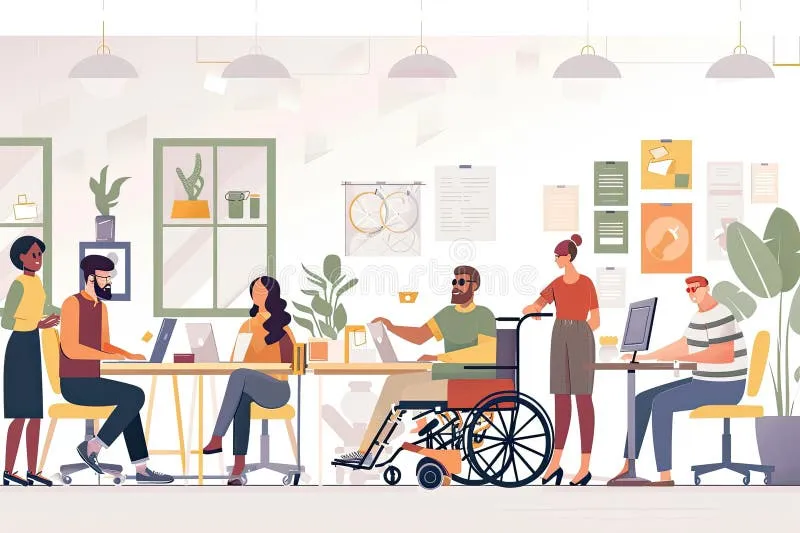
Photo: diverse professional team collaborative workspace inclusive office environment, via thumbs.dreamstime.com
Daniel was 29 years old when he finally stopped trying to perform neurotypicality in job interviews.
For seven years, he had rehearsed eye contact in bathroom mirrors, practiced the cadence of small talk, memorized scripts for behavioral questions designed to assess cultural fit. He holds a master's degree in computer science from a well-regarded state university. His code, his former professors say, is elegant in a way that is genuinely uncommon. None of that seemed to matter once the interview began and the performance started to slip.
"I would freeze on questions like, 'Tell me about a time you demonstrated leadership,'" said Daniel, who was diagnosed with autism spectrum disorder at age 24. "Not because I didn't have an answer, but because I had seventeen answers simultaneously and couldn't determine which one was correct to give."
He eventually found work — not through a standard application process, but through a nonprofit employment program specifically designed for autistic adults. Within two years, he was leading a team. His manager describes him as the most methodical problem-solver she has ever supervised.
Daniel's trajectory is neither a feel-good exception nor a cautionary tale. It is a data point in a pattern that American corporate culture has been slow to examine and slower to change.
The Sorting Machine
The modern hiring process is, by design, a filtering system. What is less often acknowledged is what, precisely, it filters for — and what it inadvertently discards.
Resumes screened by algorithm. Group interviews that reward extroversion. Open-plan offices that punish sensory sensitivity. Performance reviews that conflate social fluency with professional competence. These are not neutral structures. They encode a specific model of human behavior and penalize deviation from it.
For the estimated 15 to 20 percent of the U.S. population that identifies as neurodivergent — a broad term encompassing autism spectrum disorder, attention-deficit/hyperactivity disorder, dyslexia, dyscalculia, Tourette syndrome, and other neurological variations — these structures function as a continuous series of disqualifying obstacles, most of which have little bearing on actual job performance.
The unemployment and underemployment rates among neurodivergent adults are striking. Research published in the journal Autism found that more than 85 percent of autistic college graduates are unemployed or underemployed. Adults with ADHD experience significantly higher rates of job instability and are more likely to be passed over for promotion despite comparable or superior technical output. Dyslexic individuals — who are, studies suggest, disproportionately represented among entrepreneurs and creative professionals — routinely report being eliminated in early screening rounds by standardized assessments that test reading speed rather than reasoning capacity.
"We have built a hiring ecosystem that is extraordinarily good at finding people who can perform well in hiring processes," said one organizational psychologist who consults with Fortune 500 companies on inclusive talent strategy. "That is not the same thing as finding people who perform well at jobs."
The Evidence They Keep Ignoring
The business case for neurodivergent inclusion is not new. It has been documented, quantified, and presented to corporate leadership for more than a decade. It has not, by most measures, produced proportionate change.
Studies conducted in partnership with companies including SAP, Microsoft, and JPMorgan Chase — all of which have implemented targeted neurodivergent hiring programs — have found that employees recruited through these initiatives frequently outperform neurotypical peers on specific metrics. JPMorgan's Autism at Work program, launched in 2015, reported that participants in certain roles were 90 to 140 percent more productive than their colleagues, with significantly lower error rates.
SAP has publicly stated that its neurodiversity hiring initiative has contributed measurable improvements to software quality and testing accuracy. Microsoft's program has produced employees who have identified systemic bugs that had evaded detection for years.
These outcomes are not surprising to researchers who study cognitive diversity. The same neurological architecture that makes an open-plan office overwhelming for an autistic engineer may also make that engineer exceptionally attuned to patterns, inconsistencies, and structural flaws in complex systems. The hyperfocus characteristic of ADHD, often framed as a liability in conventional productivity frameworks, can produce extraordinary depth of expertise when channeled into meaningful work.
The problem is not a lack of evidence. It is a lack of institutional will to act on it.
Profiles in Persistence
Amara, 34, was diagnosed with dyslexia and ADHD in her early thirties — after a decade of being labeled as smart but unfocused, capable but unreliable. She works now as a UX designer at a mid-sized tech firm in Austin that partnered with a neurodiversity consulting organization to overhaul its onboarding and performance management systems.
The changes her employer made were not dramatic. Written instructions supplemented verbal ones. Deadlines were communicated in multiple formats. She was offered a private workspace for deep-focus tasks. Her performance reviews shifted from assessing behavior to assessing outcomes.
"I went from being the person who was always almost fired to being the person whose work was featured in the company's portfolio," she said. "Nothing about my brain changed. The environment did."
That reframing — from fixing the person to adjusting the environment — is at the center of what advocates call the neurodiversity paradigm. It draws, in part, from the social model of disability, which locates the source of disadvantage not in individual difference but in the design of social and institutional systems.
For employers, the practical implications are less philosophical than they might appear. Many of the accommodations that most benefit neurodivergent employees — clear communication, flexible scheduling, structured feedback, reduced sensory stimulation — are improvements that benefit the broader workforce as well.
What Genuine Inclusion Requires
The companies most often cited as models for neurodivergent inclusion share certain characteristics. They have moved beyond diversity statements into operational change. They have trained managers not merely in awareness but in practical accommodation. They have redesigned interview processes to assess relevant competencies through work samples, structured tasks, or extended evaluation periods rather than high-stakes one-hour conversations.
Perhaps most critically, they have created cultures in which disclosure does not function as a professional liability. In the absence of psychological safety, neurodivergent employees who do manage to navigate the hiring process frequently spend enormous energy masking — suppressing behaviors, mimicking social conventions, performing a version of themselves that the workplace finds legible. Masking is exhausting. It is also associated, in the research literature, with significantly elevated rates of anxiety, depression, and burnout.
The talent is there. It always has been. What American corporate culture has consistently failed to provide is the conditions under which that talent can actually surface.
Daniel, the software engineer who now leads a team, offers a characteristically precise summary of the situation.
"The question companies keep asking is, 'How do we help neurodivergent people succeed in our systems?'" he said. "The better question is: 'What are our systems missing by being built for only one kind of mind?'"
It is a question that, if taken seriously, would require more than a hiring initiative. It would require a fundamental reassessment of what capability looks like — and who gets to define it.