Raising Someone Else's Children: The Grandparents and Relatives Quietly Holding American Families Together
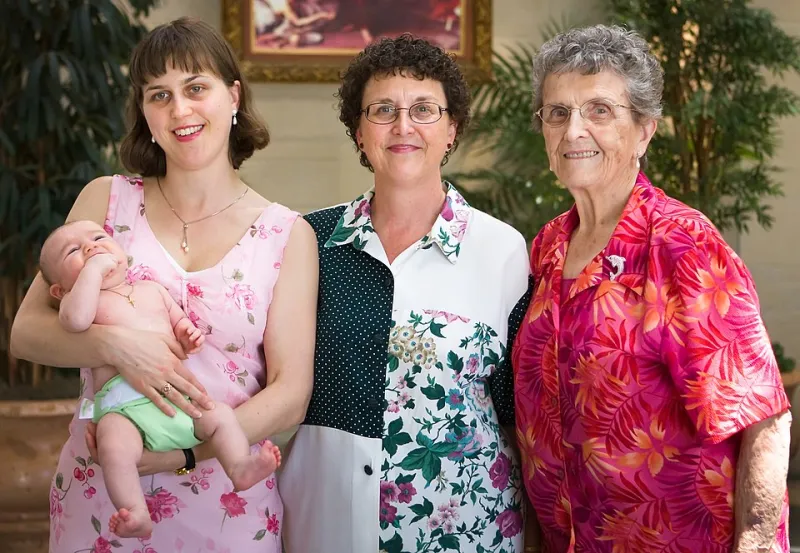
Photo: Azoreg, CC BY-SA 3.0, via Wikimedia Commons
Dorothy is sixty-seven years old, and she is doing homework.
Not her own. She is sitting at a kitchen table in Louisville, Kentucky, helping her nine-year-old grandson Marcus work through a third-grade math worksheet. She has been doing this, in one form or another, for four years — since the night her daughter arrived at her door in crisis, left the boy and his younger sister, and did not come back. Dorothy's daughter is somewhere in the grip of an opioid addiction that has consumed the better part of a decade. Dorothy does not know exactly where she is tonight.
"I didn't plan for this," Dorothy says, without bitterness. "But he's mine. They both are. What was I supposed to do?"
Dorothy's situation is, by any measure, extraordinary in its emotional weight. It is also, statistically, entirely ordinary. Across the United States, the U.S. Census Bureau estimates that approximately 2.5 million grandparents are serving as the primary caregivers for their grandchildren. When the broader category of kinship care — which includes aunts, uncles, older siblings, and family friends — is considered, the number of children being raised outside their parental home but within their extended family networks rises to well over four million.
They constitute a vast, largely invisible caregiving infrastructure. And they are doing it almost entirely without help.
The Invisible Safety Net
The American child welfare system was designed, in its essential architecture, around two outcomes: reunification with biological parents or adoption by new families. Kinship care — the practice of placing children with relatives when parents cannot safely care for them — has always occupied an awkward third space in that framework, simultaneously essential to the system's functioning and peripheral to its institutional priorities.
In many cases, relatives like Dorothy never formally engage with the child welfare system at all. They absorb children informally, outside of court orders or agency supervision, because the alternative — watching a grandchild enter foster care — is unthinkable. This informal arrangement protects children from the documented trauma of institutional placement. It also means that the caregivers receive virtually nothing in return: no guaranteed financial assistance, no automatic legal authority to make medical or educational decisions, no access to the support services that licensed foster parents receive as a matter of course.
A grandmother who takes in her grandchildren informally has no more legal standing in their lives than a neighbor. She cannot consent to a surgical procedure. She may struggle to enroll a child in school. If the child's parent reappears and demands custody, she has few reliable legal protections, regardless of how long she has been the child's primary caregiver.
"The law simply hasn't caught up with the reality of how families actually function," says one family law attorney who specializes in kinship placement cases in the Southeast. "These caregivers are doing the work of the state, absorbing the costs of the state's failures, and the state is largely pretending they don't exist."
Who Is Affected, and Why
The forces driving children into kinship care are, in large part, the forces that define America's most persistent social crises.
The opioid epidemic has been perhaps the single largest driver of kinship placement over the past fifteen years. States that were hit earliest and hardest by the overdose crisis — West Virginia, Kentucky, Ohio, New Hampshire — saw corresponding surges in grandparent-headed households as parents succumbed to addiction, incarceration, or death. According to research published by the Annie E. Casey Foundation, the number of children living in households headed by grandparents or other relatives increased significantly in counties with the highest rates of drug-related mortality.
Mass incarceration is another defining factor. With the United States maintaining the highest incarceration rate of any developed nation, the collateral consequences fall heavily on children — and on the grandmothers, aunts, and older siblings who step in to care for them. Research consistently finds that kinship caregivers are disproportionately women of color, disproportionately low-income, and disproportionately older, which means they are absorbing the caregiving burden at precisely the moment in their lives when they are most economically and physically vulnerable.
Dorothy, for instance, had planned to retire at sixty-five. Instead, she returned to part-time work as a home health aide to cover the additional costs of raising two young children on a fixed income. She has put off a knee replacement she needs. She does not take vacations. She does not complain about any of this. But the financial strain is real, and it is aging her.
The Policy Gap
Federal and state policies governing kinship care are a patchwork of partial solutions, bureaucratic barriers, and glaring omissions.
Foster care payments — which can range from several hundred to over a thousand dollars per month depending on the state — are available to licensed kinship foster parents. But licensing requirements, which vary by state, can be prohibitive for relatives who lack the financial resources, housing space, or time to navigate a process designed for non-relative foster families. Many grandparents, particularly those in lower-income households, fail to qualify and receive nothing.
The Kinship Navigator Program, funded through the Family First Prevention Services Act of 2018, was intended to connect kinship caregivers with available resources. Implementation has been uneven, and funding remains far below what advocates say is necessary to reach the full population of informal kinship caregivers.
Legal guardianship, which would provide grandparents with formal authority over their grandchildren's lives, requires navigating a court system that many families find inaccessible without legal representation — representation that is rarely provided at public expense in civil proceedings.
"We have a system that works reasonably well for the families it was designed for," observes one child welfare policy researcher. "But it was designed for a narrower reality than the one that actually exists."
What Endures
In Louisville, Marcus has finished his math worksheet. His younger sister, six-year-old Amara, is asleep in the next room. Dorothy makes tea and speaks quietly about what she hopes for them — college, maybe, or trade school, or whatever makes them happy. She speaks about their mother with a careful tenderness that avoids both false hope and despair.
What is most striking, in her telling and in the stories of kinship caregivers across the country, is the absence of self-pity. These are people who made a choice — or, more accurately, recognized that for them there was no real choice — and who have organized their lives around its consequences with a dignity that the policy debate rarely pauses to acknowledge.
They are not a crisis waiting to be solved. They are a solution that has already been deployed, quietly and at enormous personal cost, by millions of ordinary Americans who understood that family is not merely a legal category but a set of obligations that endure when institutions fail.
What they deserve, at minimum, is for the rest of the country to see them clearly — and to build a policy framework worthy of what they have already given.