Rooted in Place: The Rural Physicians Defying a System That Keeps Forgetting Them
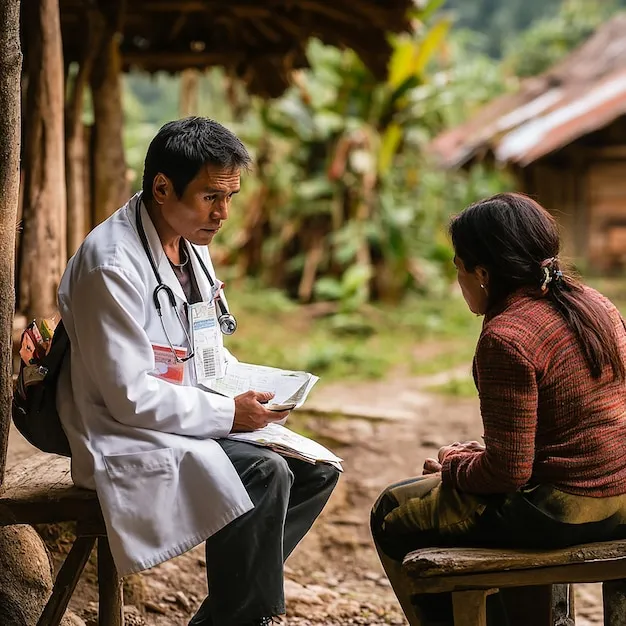
Photo: rural doctor small town clinic examining patient, via img.freepik.com
Dr. Linda Hargrove drives forty minutes to reach her farthest patients. Not forty minutes through congested city traffic — forty minutes through the kind of silence that presses against the windows of a moving car on an unmarked two-lane road in eastern Kentucky. She has made that drive, in some variation, for twenty-two years. She knows the names of the dogs on the porches. She remembers which families lost someone to the opioid crisis, and which ones are still losing.
"I didn't stay because I couldn't leave," she says, without a trace of defensiveness. "I stayed because this is where medicine means something."
Hargrove is part of a community of practitioners — dispersed, underrecognized, and chronically under-resourced — who have chosen to anchor their professional lives in rural America. They represent something increasingly rare: physicians who have measured the financial incentives of urban practice, weighed the institutional prestige of academic medicine, and arrived at a different calculation entirely.
A Map of Absence
The numbers behind their decision are stark. According to the Health Resources and Services Administration, more than 60 million Americans live in areas officially designated as Health Professional Shortage Areas. Rural counties, which account for roughly 97 percent of the nation's landmass, are home to only about 10 percent of its physicians. The math, as one family practitioner in rural Montana put it, "doesn't work for patients or for doctors."
The physician shortage in these regions is not a recent development. It is the accumulated consequence of decades of policy decisions that have favored specialty care over primary care, urban infrastructure over rural investment, and market-driven medicine over community-centered practice. Medical school debt — now averaging over $200,000 per graduate — has made the financial logic of rural practice increasingly untenable. Urban and suburban positions reliably offer higher salaries, better equipment, and the professional networks that help careers advance.
And yet, some physicians stay. Others arrive, often through federal programs like the National Health Service Corps, which offers loan repayment in exchange for service in underserved areas, and find themselves unable to leave once their required years are complete.
What Keeps Them
For Dr. Marcus Osei, a family physician in a small town in the Mississippi Delta, the answer to why he remains is inseparable from who he is. A son of Ghanaian immigrants who grew up watching his parents navigate a healthcare system that treated them as afterthoughts, Osei arrived in Sunflower County through the NHSC program and stayed when his commitment ended.
"The patients here have the same needs as patients anywhere," he says. "They just have fewer people willing to show up for them."
This is a sentiment echoed with striking consistency among rural practitioners. What they describe is not a romantic attachment to simplicity or a rejection of ambition, but something more grounded: a belief that continuity of care — knowing a patient over years, across generations, across the full arc of their health — is itself a form of medical excellence that the urban system rarely allows.
In rural practice, the boundaries between physician and community are porous in ways that can be both demanding and sustaining. A doctor may treat the school principal in the morning and the school principal's elderly mother in the afternoon. They may sit on the county health board, speak at the high school, and be recognized at the grocery store by patients who have no other reliable source of medical counsel.
"You can't be anonymous here," says Dr. Priya Nandakumar, who practices in a rural county in central Texas. "That's hard sometimes. But it also means the work is real in a way I don't think I could find anywhere else."
The Weight of Systemic Neglect
The personal commitment these physicians bring does not neutralize the structural forces working against them. Rural hospitals across the country have been closing at an accelerating rate — more than 140 have shuttered since 2010, according to the Chartis Center for Rural Health, with dozens more operating under severe financial strain. When a rural hospital closes, it rarely just eliminates beds. It eliminates the broader ecosystem that makes rural medical practice viable: specialist consultations, diagnostic imaging, emergency backup, and the professional community that helps prevent burnout.
Physicians who remain after a hospital closure often describe a quiet, grinding exhaustion — not from overwork alone, but from the awareness that the safety net beneath them has been removed. Referrals become more complicated. Emergencies become more dangerous. The distance between a patient's condition and the appropriate level of care becomes, quite literally, longer.
Telehealth has offered partial relief, particularly following its rapid expansion during the COVID-19 pandemic. But rural practitioners are careful not to overstate its promise. Broadband access remains unreliable across much of rural America. Older patients, who represent a disproportionate share of rural populations, often face barriers to digital navigation. And there are dimensions of care — the physical examination, the reading of a room, the trust built through presence — that a screen cannot replicate.
Reshaping the Conversation on Healthcare Equity
What rural physicians are doing, whether or not they frame it this way, is making an argument with their lives. They are demonstrating that healthcare equity is not only a matter of insurance coverage or legislative mandate — it is a matter of who chooses to be present, and what systems are built to support that presence.
Several medical schools have begun to respond. Programs targeting students from rural backgrounds, rural training tracks, and community-based residencies have shown promise in producing physicians more likely to practice in underserved areas. Research consistently indicates that the strongest predictor of rural practice is rural origin — that doctors who grew up in small towns are substantially more likely to return to them.
Advocates argue this data should fundamentally reshape how medical education is funded and structured. If the pipeline problem is partly a pipeline design problem, then the solution is not simply to incentivize urban-trained physicians to relocate, but to invest in cultivating practitioners from the communities that need them most.
The Ones Who Anchor
Back in eastern Kentucky, Dr. Hargrove is preparing for an afternoon of appointments. Her waiting room holds a mix of patients: a retired coal miner managing chronic lung disease, a young mother navigating postpartum depression without access to a mental health specialist, an elderly man who drove forty-five minutes because she is the only physician he trusts.
She is not unaware of what she has foregone. She has colleagues who earn twice her salary in cities four hours away. She has watched medical school classmates accumulate the markers of professional prestige that her practice rarely offers.
"But I also know my patients," she says. "I know their histories. I know what they're afraid of. That's not nothing. That's actually everything."
The rural physicians who have made this choice are not simply filling a gap in the healthcare map. They are insisting, through sustained daily practice, that the people who live beyond the metropolitan edge are worth showing up for — and that a healthcare system worthy of the name must eventually find a way to agree.