Hands That Know: The Vanishing Wisdom of America's Master Craftspeople
In a small electrical contracting shop on the outskirts of Youngstown, Ohio, a man named Gerald Pruitt has spent the better part of four decades reading buildings the way other people read faces. He knows, by the particular flicker of a fluorescent fixture and the faint smell of warm insulation, that a junction box three floors above is about to fail. He has never written this down. He is not entirely sure he could.
"You don't learn it from a book," Pruitt, 67, says, wiping his hands on a rag he keeps tucked into his belt. "You learn it from being wrong a hundred times and remembering why."
Pruitt plans to retire within the year. His shop has two apprentices, both under thirty, both capable. Neither of them, he admits quietly, is ready for what he knows — and he is running out of time to show them.
His situation is not exceptional. It is, increasingly, the norm.
The Knowledge That Lives in the Body
Economists and workforce researchers have a term for what Pruitt carries: tacit knowledge. It refers to the accumulated, experience-derived understanding that resists easy codification — the intuitions, improvisations, and finely calibrated judgments that distinguish a master from a merely competent practitioner. Unlike explicit knowledge, which can be written into a procedure manual or uploaded to a training portal, tacit knowledge is transmitted through proximity, repetition, and mentorship. It is, by definition, difficult to transfer and nearly impossible to recover once it is gone.
The United States is currently losing it at a scale that should alarm policymakers, industry leaders, and communities alike.
According to the Bureau of Labor Statistics, more than 10,000 Baby Boomers reach retirement age every day. A significant proportion of them work — or worked — in skilled trades: tool-and-die makers, master electricians, journeyman plumbers, specialty bakers, precision machinists, glassblowers, and hundreds of other vocations that underpin the physical infrastructure of American life. Many of these fields were already contending with labor shortages before the pandemic accelerated retirements and disrupted apprenticeship pipelines. The result is a widening expertise gap that threatens not only economic productivity but something harder to quantify: the living continuity of craft itself.
A Succession Crisis Without a Name
In Louisville, Kentucky, a third-generation bakery owner named Sylvia Marchetti-Odom is grappling with a version of this problem that keeps her awake at night. Her grandmother arrived from Calabria in 1951 and built a business around bread — specifically, around a sourdough starter culture and a shaping technique that produces a crust her customers have driven across the city to purchase for sixty years.
Marchetti-Odom, 54, has tried to document the method. She has filmed herself working. She has written detailed notes. None of it, she says, captures what her hands actually do.
"The pressure changes depending on the humidity, the temperature, how long the dough rested," she explains. "There's no formula. There's just feel. And feel takes years."
Her most experienced baker, a man who worked alongside her grandmother, retired last spring. The institutional memory he carried — the adjustments, the workarounds, the accumulated seasonal wisdom — left with him. Marchetti-Odom is rebuilding, slowly, from what she can reconstruct.
This pattern repeats across industries with striking consistency. In precision manufacturing, veteran tool-and-die makers are retiring from shops in Michigan, Pennsylvania, and the Carolinas without formal knowledge-transfer protocols in place. In the electrical trades, master electricians who spent decades specializing in legacy industrial systems — equipment that still powers hospitals, water treatment facilities, and municipal infrastructure — are leaving workforces that have no one trained to replace their expertise. In construction, finish carpenters and restoration masons with deep knowledge of pre-war building techniques are aging out of a workforce that has increasingly prioritized speed over craft.
The Pipeline Problem
The erosion of apprenticeship as a dominant model for skills transmission is both a cause and a consequence of this crisis. For decades, American education policy has steered young people away from vocational training and toward four-year college degrees, embedding a cultural hierarchy that frames manual expertise as a lesser ambition. The result has been a generation-long underinvestment in the systems — union apprenticeship programs, community college trade tracks, employer-sponsored mentorship initiatives — through which tacit knowledge has historically moved from one generation to the next.
The consequences are now structural. The average age of a journeyman electrician in the United States is over 40. The average age of a precision machinist is higher still. In some specialty trades, the pipeline of new entrants is so thin that industry associations speak openly of a coming skills cliff — not a gradual decline but a sudden, disruptive drop in available expertise.
"We spent thirty years telling kids that college was the only path to dignity," says Dr. Renata Figueroa, a workforce development researcher at a Midwest policy institute. "Now we're paying for that in ways that are very concrete and very expensive."
What Is Lost When the Knowledge Goes
The economic costs are measurable, if imprecisely. Construction delays, equipment failures, quality degradation, and the elevated expense of recruiting specialists from shrinking talent pools all carry dollar values. Industry groups estimate that the skilled trades shortage costs the U.S. economy tens of billions of dollars annually in lost productivity and deferred infrastructure maintenance.
But there is another dimension to this loss that resists easy monetization. Craft knowledge is not merely technical. It is cultural. It encodes the history of industries, the ingenuity of working communities, and the particular intelligence that develops when human beings spend decades learning to work with their hands and their minds simultaneously. When a master glassblower retires without passing on her methods, or when a tool-and-die shop closes because no one trained to carry it forward, something more than a skill set disappears. A way of knowing — rooted in place, in time, and in the specific texture of physical labor — goes with it.
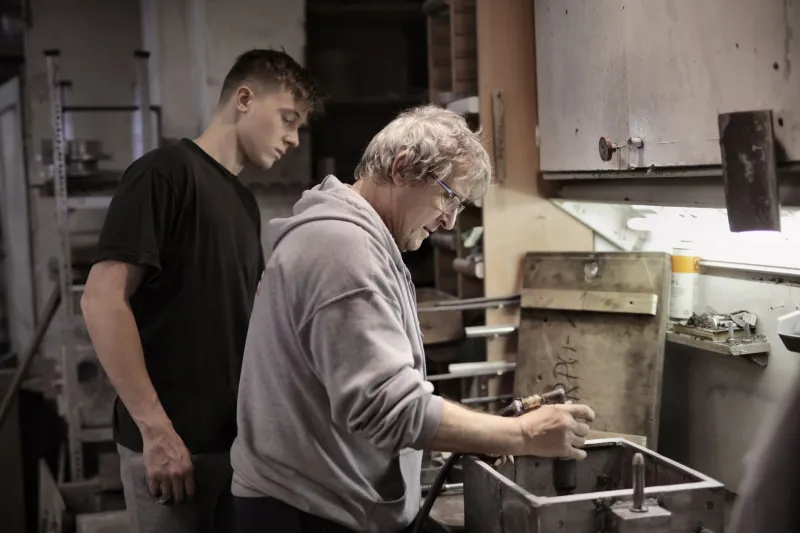
Gerald Pruitt understands this, even if he would not phrase it that way. On a recent afternoon, he spent three hours walking one of his apprentices through a diagnostic process that he has performed hundreds of times, narrating his reasoning aloud, stopping to explain not just what he was doing but why — and more importantly, what he was feeling.
"I'm trying to put words to something that doesn't really have words," he said afterward. "But you have to try. Because if I don't, it's just gone."
The question facing American industry, and American society more broadly, is whether enough people in positions of institutional power are listening — and whether they will act before the last keepers of this knowledge walk out the door for the final time.