Cities in Denial: The Human Cost of Sweeping America's Homeless Encampments Under the Rug
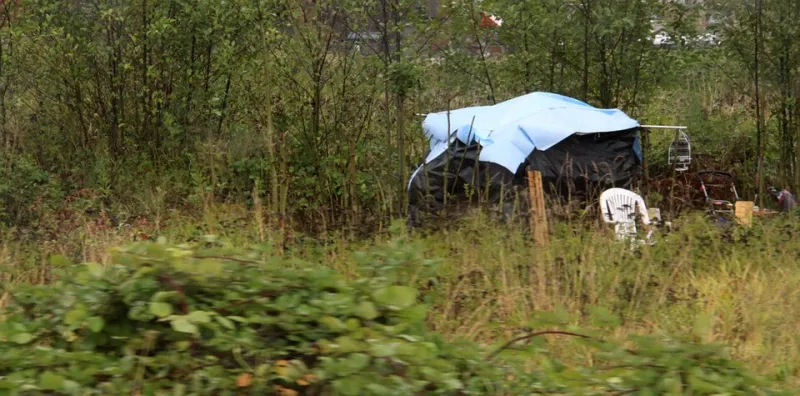
Photo: waferboard, CC BY 2.0, via Wikimedia Commons
On a Tuesday morning in late October, city workers arrived at a stretch of riverbank in Sacramento, California, armed with hazmat suits, orange cones, and a notice posted just 72 hours earlier. Within four hours, everything that remained of a community of roughly 60 people — photographs, medication, hand-sewn quilts, the small details that distinguish a life from mere survival — had been loaded into dump trucks. By afternoon, the riverbank was empty. By the following week, most of the displaced residents had reappeared six blocks north, beginning again.
This cycle — encampment, sweep, displacement, repeat — has become one of the defining rhythms of urban America. Yet the people caught inside it remain largely invisible to the broader public, their stories filtered through political rhetoric or reduced to statistics in policy briefs. What is lost in that reduction is the texture of actual human experience: the networks of mutual care, the improvised governance, the quiet dignity that persists even in conditions most Americans would find unimaginable.
A Crisis With Deep Institutional Roots
The scale of unsheltered homelessness in the United States is staggering. According to the most recent point-in-time count conducted by the Department of Housing and Urban Development, more than 650,000 Americans experienced homelessness on a single night in January 2023 — a figure that researchers and advocates widely acknowledge as a significant undercount, given the inherent difficulty of tallying people who, by definition, occupy informal and often hidden spaces.
The causes are neither mysterious nor inevitable. Decades of disinvestment in public housing — accelerated by the demolition of large-scale federal housing projects beginning in the 1990s and never adequately replaced — created a structural deficit that the private rental market has shown no interest in filling. Stagnant wages, the erosion of mental health infrastructure following deinstitutionalization in the 1980s, a fragmented and chronically underfunded addiction treatment system, and the catastrophic economic disruptions of the COVID-19 pandemic have each contributed layers to a crisis that now touches every major American city and an increasing number of smaller ones.
"People talk about homelessness like it's a personal failing," says Dr. Marguerite Hollins, a public health researcher at UCLA who has spent fifteen years studying unsheltered populations. "But when you look at the data, what you're really seeing is the cumulative effect of policy decisions — decisions about what we fund, what we build, and who we decide deserves a safety net."
The Architecture of Encampments
To spend time inside an established encampment is to encounter something that defies the narrative of chaos that city officials so often invoke to justify clearances. Many encampments develop recognizable social structures: informal leaders who mediate disputes, shared rules about noise and cleanliness, systems for distributing donated food and supplies. In Portland, Oregon, a resident-governed encampment known informally as "the Village" maintained a functioning library of donated books and a rotating schedule of communal cooking. In Houston, encampment residents organized their own trash collection after city services declined to extend coverage to their location.
These adaptations are not incidental. They reflect the same human impulse toward community and order that shapes any neighborhood — expressed under conditions of radical scarcity and institutional abandonment.
Jerome Watkins, 54, has lived in an encampment along a freeway underpass in Los Angeles for nearly three years. Before that, he worked as an electrician for two decades. A workplace injury, a gap in insurance coverage, an opioid prescription that became a dependency, and a landlord who would not wait — the sequence is familiar to anyone who has listened carefully to the stories of unhoused Americans. "People think we gave up," he says. "We didn't give up. We got pushed out, and then we got pushed out again, and eventually you stop being surprised by it."
The Politics of Displacement
The Supreme Court's 2024 ruling in City of Grants Pass v. Johnson fundamentally altered the legal landscape governing encampment clearances, effectively permitting cities to enforce anti-camping ordinances even in the absence of sufficient shelter capacity. The decision was celebrated by municipal governments frustrated by legal challenges to their sweep operations. Critics, including a broad coalition of civil rights attorneys and housing advocates, argued that it amounted to the criminalization of poverty itself.
In the months following the ruling, cities from Phoenix to Chicago accelerated their clearance operations. Shelter intake numbers rose modestly in some jurisdictions; in many others, displaced residents simply moved to new locations, cycling through the same precarity with fewer legal protections.
"A sweep is not a solution," says Destiny Lopez, a community organizer with a Los Angeles-based housing advocacy organization. "It's a solution to the discomfort of people who don't want to see the problem. The people who were living there don't disappear. They just disappear from your line of sight."
What Genuine Solutions Look Like
Amid the failures of conventional policy approaches, a number of grassroots and nonprofit organizations have developed models that offer a more honest reckoning with the problem's complexity. Houston's coordinated homelessness response system, built around a Housing First philosophy that prioritizes placing individuals in stable housing before addressing other challenges, has produced measurable reductions in chronic homelessness over the past decade. The model requires sustained political commitment and significant funding — precisely the conditions that most cities have been unwilling to sustain.
In smaller cities, community land trusts and resident-led transitional housing programs have demonstrated that the people most directly affected by the crisis are often its most capable problem-solvers, when given resources and genuine authority rather than token consultation.
The evidence, taken together, points toward a conclusion that is straightforward even if it is politically inconvenient: encampments are not a symptom of individual failure. They are the visible residue of institutional choices — choices about housing investment, mental health funding, wage floors, and the social contract itself. Making those choices differently is not a technical challenge. It is a question of political will and moral priority.
For Jerome Watkins, the abstractions of policy debate are beside the point. "I just want a door I can close," he says. "That's it. A door I can close and know is mine." It is, by any measure, a modest request. The fact that it remains unmet for hundreds of thousands of Americans is not an accident. It is a choice — and choices, unlike accidents, can be made differently.